Podcast ads have become one of the more interesting corners of digital advertising because they sit somewhere between performance marketing and relationship-building. A listener might hear an ad while driving to work, walking the dog, cooking dinner, or taking a quiet break between meetings. That kind of attention is different from scrolling past a banner or skipping a video before it starts.
The challenge, of course, is that podcast listeners are not passive in the same way. They often feel connected to the host, the topic, and the rhythm of the show. When an ad fits naturally, it can feel useful. When it sounds forced, overly scripted, or completely unrelated to the audience, it can interrupt the trust that made the placement valuable in the first place.
For advertisers, podcast advertising is not just about buying audio space. It is about choosing the right podcast ad format, matching the message to the listener’s mindset, and giving people a reason to remember the brand after the episode ends.

What Are Podcast Ads?
Podcast ads are paid audio messages placed within podcast episodes to promote a brand, product, service, event, or campaign. They can be read by the podcast host, voiced by a professional announcer, or inserted dynamically based on audience targeting, location, timing, or campaign goals.
At their best, podcast ads feel more like a relevant recommendation than a traditional interruption. That is why brands in software, healthcare, finance, education, lifestyle, direct-to-consumer products, and B2B services continue to invest in podcast advertising. The channel allows advertisers to reach people during moments when they are often more focused and less distracted than they are on crowded visual platforms.
A good podcast ad usually answers three simple questions quickly: Why should the listener care? Why does this brand belong on this show? What should the listener do next? If those questions are not clear, even a well-produced ad can disappear into the background.
5 Podcast Ad Examples That Show How Smart Audio Advertising Works
Podcast ads can take many forms, but the best ones all have one thing in common: they fit naturally into the listener’s experience. From host-read recommendations to dynamic ads tailored by location or audience, each format serves a different purpose. These five podcast ad examples show how advertisers can use storytelling, timing, trust, and relevance to make their message more memorable.
Podcast Ad Example 1: Host-Read Ad for a Finance App
Imagine a budgeting app advertising on a personal finance podcast. The audience is already thinking about saving money, paying off debt, managing subscriptions, and making better financial decisions. This is a strong audience fit, but the ad still needs to feel personal.
A weak ad might say, “Download our app to manage your money smarter.” That is technically clear, but it does not create much interest. A stronger host-read ad might begin with a familiar situation: “I used to think I knew where my money was going, until I looked at three months of small automatic payments.” That small observation gives the listener a reason to pay attention.
The solution is to make the ad specific. Instead of listing every app feature, focus on one real problem the listener recognizes. Maybe the app helps people find forgotten subscriptions, build a weekly grocery budget, or separate personal and business expenses. One believable use case will usually outperform five vague benefits.
This kind of podcast ad works because money is personal. A trusted host can lower the listener’s guard by speaking honestly about habits, mistakes, and small improvements. The ad does not need to sound dramatic. It needs to sound useful.
Podcast Ad Example 2: Mid-Roll Ad for a Meal Kit Brand
Mid-roll ads appear during the middle of an episode, often after the listener is already engaged. This placement can be valuable because the audience has settled into the show and is less likely to abandon the episode immediately.
A meal kit brand advertising on a parenting podcast could use this moment well. Instead of opening with “Fresh ingredients delivered to your door,” the ad could start with a scene most parents understand: it is almost 6 p.m., everyone is hungry, and nobody has decided what dinner is. That situation is simple, but it is emotionally accurate.
The ad can then position the meal kit as a practical solution, not a lifestyle fantasy. It saves a grocery trip. It reduces decision fatigue. It gives families a few reliable meals during a busy week. These details matter because the listener is not buying ingredients alone. They are buying relief from one recurring daily problem.
For advertisers, the lesson is to build the ad around the listener’s actual moment of need. Podcast ads become stronger when they start with the problem in plain language, then connect the product to a realistic solution.
Podcast Ad Example 3: Pre-Roll Ad for a Local Healthcare Provider
Pre-roll ads run near the beginning of a podcast episode. They need to work quickly because the listener has not yet fully settled into the content. This format is often best for simple, memorable messages.
A local healthcare provider might use pre-roll ads across community news, parenting, and local business podcasts. The goal is not to explain every medical service. The goal is to become the name people remember when they need care.
A strong pre-roll ad might mention same-week appointments, extended hours, nearby clinics, or online booking. These are concrete details that help the listener understand the benefit immediately. A vague message about “quality care for your family” is less useful because nearly every healthcare provider could say the same thing.
The solution is to keep pre-roll ads focused. One audience, one need, one clear next step. For local advertisers, location-based relevance can make a major difference. Mentioning the neighborhood, city, or specific service area helps the ad feel closer to the listener’s real life.
Podcast Ad Example 4: Branded Segment for a B2B Software Company
Some products are not bought after one short ad. B2B software, cybersecurity tools, HR platforms, and enterprise services often have longer buying cycles. In these cases, a branded segment can be more effective than a simple promotional spot.
For example, a cybersecurity company might sponsor a weekly segment on a technology leadership podcast. The segment could cover practical topics like vendor risk, employee password habits, incident response planning, or common mistakes in cloud security. The sponsor is mentioned clearly, but the content still gives the listener something valuable.
This approach works because professional buyers often need education before they are ready for a sales conversation. A CTO, IT manager, or operations leader may not click immediately, but repeated exposure to useful insights can build familiarity and trust over time.
The solution is to avoid turning the segment into a disguised sales pitch. Listeners can tell when educational content is just brochure copy with a better title. The strongest branded segments respect the audience’s intelligence. They teach first, then connect the sponsor naturally to the topic.
Podcast Ad Example 5: Dynamic Ads for an E-Commerce Brand
An e-commerce brand with multiple product categories can use dynamic podcast ads to reach different audiences with more relevant messages. For example, a fitness apparel company might promote running gear on health podcasts, work-from-home comfort wear on business podcasts, and seasonal offers on lifestyle shows.
The advantage is flexibility. If a winter sale ends, the advertiser can replace that message. If a product sells out, the campaign can shift to another offer. If one region responds better to a certain message, the brand can adjust without rebuilding the entire campaign.
Dynamic ads also help advertisers test creative. One version might focus on free shipping. Another might focus on product durability. A third might mention customer reviews. Over time, the advertiser can see which message drives stronger response and use that insight to improve future campaigns.
The solution is not to create dozens of random variations. Start with a few meaningful differences based on audience intent, geography, or offer. Testing works best when each variation has a clear reason behind it.
How Advertisers Can Maximize Podcast Ad Reach?
Maximizing podcast ad reach does not mean buying as many impressions as possible and hoping for the best. Reach becomes valuable only when the right people hear the right message enough times to remember it.
The first step is choosing shows based on listener mindset, not just podcast category. A productivity software brand may naturally look at business podcasts, but the same audience might also listen to entrepreneurship, remote work, career development, or even parenting podcasts. The smarter question is: what is the listener trying to improve in their life or work?
Advertisers should also balance large podcasts with niche shows. Larger podcasts can provide efficient scale, but smaller shows may offer stronger relevance and deeper trust. A niche podcast with a loyal audience of HR leaders, independent consultants, or new parents can sometimes deliver better results than a broad show with a much larger audience.
Another practical solution is to plan for frequency. One exposure is rarely enough. A listener may hear the first ad while distracted, the second while interested, and the third when the need is finally relevant. Good podcast media planning considers how often people will hear the message, not just how many total downloads the campaign reaches.
Improve Creative Before Increasing Spend
One of the most common mistakes in podcast advertising is blaming the channel before fixing the message. If the creative is vague, too long, too scripted, or poorly matched to the show, increasing the budget will only scale the weakness.
Advertisers should review the ad from the listener’s perspective. Does it sound like it belongs in the episode? Is the problem clear within the first few seconds? Is there one strong reason to care? Is the call to action easy to remember? These questions are simple, but they often reveal why a campaign is underperforming.
A better podcast ad usually does not need more hype. It needs sharper thinking. Replace broad claims with real situations. Replace feature lists with outcomes. Replace complicated calls to action with one clean next step.
Measure More Than Downloads
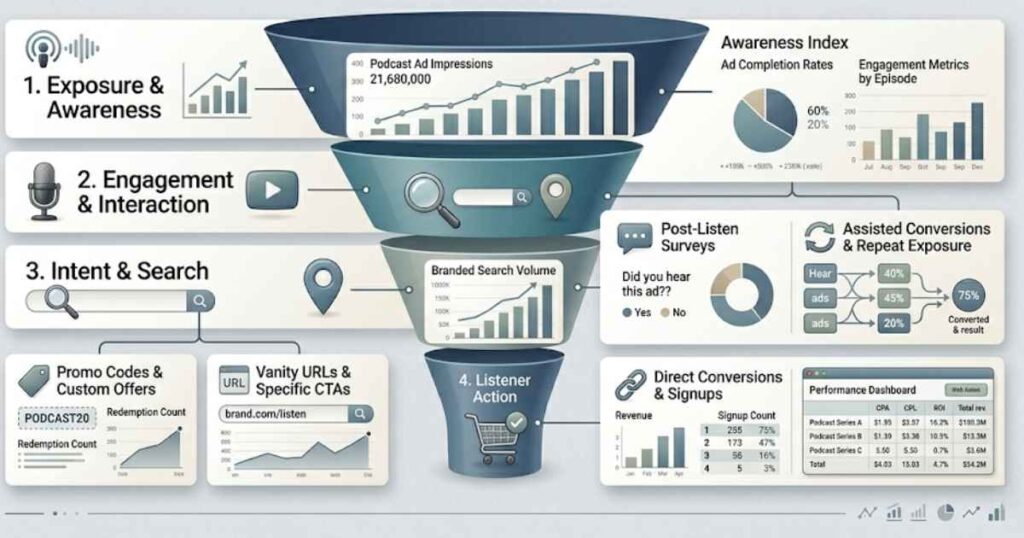
Downloads matter, but they do not tell the full story. A podcast download does not always mean a full listen, and a listener may hear an ad today but take action days or weeks later. That is why podcast advertising should be measured through a mix of signals.
Advertisers can track promo codes, vanity URLs, landing page visits, branded search lift, surveys, post-purchase questions, assisted conversions, and repeat exposure. For larger campaigns, brand lift studies and incrementality testing can provide a clearer picture of impact.
The solution is to define success before the campaign starts. A direct response campaign may focus on sign-ups or purchases. A brand campaign may focus on reach, recall, search lift, or audience familiarity. Without that clarity, teams often argue over numbers that were never connected to a real goal.
Conclusion
Podcast ads work because they reach people in a listening environment built on attention, habit, and trust. That is a rare combination. But it also means advertisers need to be more thoughtful than they might be in other channels. A podcast audience can usually tell when a brand understands the show and when it is simply renting space.
The strongest podcast advertising campaigns are not necessarily the loudest or most polished. They are the ones that feel relevant, useful, and well-placed. They respect the listener’s time, give the host room to sound natural, and make the next step easy.
For advertisers trying to maximize reach, the real opportunity is not just reaching more ears. It is reaching the right listeners with a message that feels worth hearing.
FAQs About Podcast Ads
What are podcast ads?
Podcast ads are audio messages placed before, during, or after a podcast episode. They can be read by the host, produced by the brand, or inserted dynamically based on audience, location, or campaign timing.
What types of podcast ads are most common?
The most common types include host-read ads, announcer-read ads, pre-roll ads, mid-roll ads, post-roll ads, baked-in ads, and dynamically inserted ads. Each format works differently depending on the campaign goal.
Are podcast ads effective?
Yes, podcast ads can be effective when the message fits the show and the audience. They work especially well when the ad feels natural, solves a real listener problem, and includes a clear next step.
How can advertisers improve podcast ad results?
Advertisers can improve results by choosing relevant shows, using clear and conversational ad copy, testing different messages, and measuring more than downloads. Promo codes, landing pages, surveys, and branded search can all help track performance.