Marketing has become far more complex than simply placing retail advertising on podcasts where people spend their time. Consumers discover products through podcasts, social media, retail marketplaces, search engines, and word of mouth before making a purchase. A shopper might hear about a new coffee brand while listening to a business podcast, compare prices on Amazon later that evening, and finally buy it during a weekly supermarket visit. With so many touchpoints involved, marketers are asking a more meaningful question than “Which ad got the click?” They want to know which marketing activity genuinely influenced the buying decision.
That is where incrementality has become one of the most valuable concepts in modern retail advertising. Instead of rewarding the last advertisement a customer interacted with, incrementality measures whether an ad generated a purchase that would not have happened otherwise. Combined with the growing influence of podcasts, this approach is helping retailers rethink how they invest in advertising budgets. Podcasts offer something increasingly rare in digital marketing engaged attention, trusted voices, and enough time to tell a compelling story rather than simply displaying a banner.

Why Does Incrementality Matter More Than Traditional Attribution?
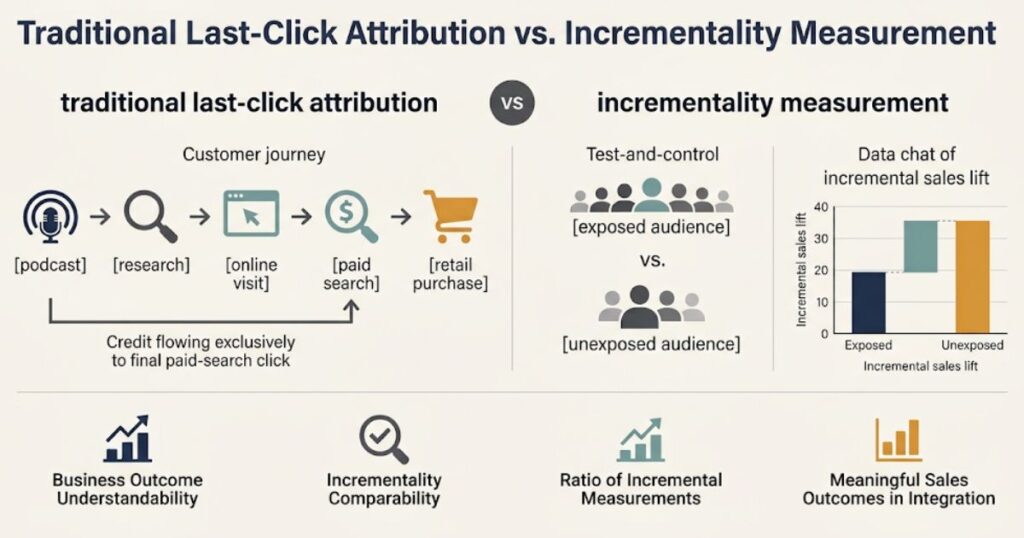
For years, marketers relied heavily on last-click attribution. While useful for tracking conversions, it often overstated the value of channels closest to the final purchase while overlooking the campaigns that created awareness in the first place. Incrementality takes a broader and more realistic view by measuring whether advertising produced genuinely new demand.
Consider a customer planning to purchase a fitness tracker. They might first hear about the product during a health podcast, later read online reviews, and finally click a paid search advertisement before buying. Under traditional attribution, the search ad may receive most of the credit, especially when podcast advertising attribution windows are too short to capture listeners who discover a brand through audio and convert days or weeks later.
Incrementality asks a different question if the podcast campaign had never existed, would the customer still have searched for that product? That distinction is especially important in performance podcast advertising, where marketers need to understand whether campaigns are generating new demand rather than simply receiving credit for purchases that would have happened anyway.
Research from Nielsen consistently shows that marketers using incrementality testing make more informed budget decisions because they identify channels that generate additional sales rather than merely redistributing existing demand. In a world where advertising budgets face constant scrutiny, proving incremental growth has become a competitive advantage.
Why Podcasts Have Become a Serious Retail Advertising Channel?
Podcast listening has moved well beyond a niche audience. According to Edison Research’s Infinite Dial, more than half of adults in many developed markets now listen to podcasts monthly, and listening continues to grow year after year. Unlike social media feeds, podcasts usually command uninterrupted attention for 30 to 60 minutes, creating an environment where advertising feels less intrusive and more conversational.
Listeners often build long-term relationships with podcast hosts. They hear their opinions every week, become familiar with their personalities, and develop a level of trust that is difficult to replicate through display advertising. That trust directly benefits brands when sponsorships feel authentic rather than scripted.
Brands such as Athletic Greens (AG1) also help illustrate why DTC brands are winning on podcasts repeated host recommendations can build familiarity and credibility long before a listener is ready to purchase. Instead of relying on short promotional messages, hosts explained how they incorporated the product into their own daily routines. Whether every listener purchased immediately was less important than the gradual build-up of familiarity and credibility across hundreds of podcast episodes.
How Podcasts Influence Buying Decisions Earlier?
One of the greatest strengths of podcast advertising is its ability to reach consumers before they begin actively shopping. Rather than interrupting someone already searching for a product, podcasts introduce ideas during moments when listeners are relaxed and receptive. This early influence often shapes future purchasing decisions, even if the final transaction happens weeks later through another channel.
Creativity Is Becoming the Biggest Competitive Advantage
Retail advertising has traditionally focused on performance metrics such as clicks, conversions, and return on ad spend. While these numbers remain important, they have also encouraged many brands to produce nearly identical advertising. Product photos, discounts, and promotional copy dominate retail media, making it increasingly difficult to stand out.
Strong creative best practices for e-commerce brands increasingly go beyond product shots and discounts, and podcasts create room for storytelling that explains why a product exists, the problem it solves, and why listeners should care. Instead of squeezing a message into a few seconds, brands can explain why a product exists, the problem it solves, or the people behind it. This emotional context helps consumers remember brands long after the episode ends.
For example, ZipRecruiter became one of the most recognised podcast advertisers by allowing hosts to explain real hiring challenges rather than simply reading feature lists. The advertising blended naturally into discussions about entrepreneurship, leadership, and business growth, making the brand relevant to the audience instead of merely visible.
Better Retail Data Is Improving Podcast Measurement
Podcast measurement has historically been one of the channel’s biggest challenges because downloads and listens alone could not show whether exposure eventually influenced retail sales. While downloads and listens provided useful information, marketers struggled to connect exposure with retail sales. That picture is changing rapidly as retail media networks continue expanding their first-party data capabilities.
Major retailers such as Amazon Ads, Walmart Connect, and Kroger Precision Marketing increasingly help brands understand customer behaviour using privacy-conscious first-party shopping data. Instead of relying solely on clicks, advertisers can evaluate whether podcast campaigns increased new customer acquisition, basket size, repeat purchases, or category penetration.
This shift aligns perfectly with incrementality testing because it focuses on business outcomes instead of vanity metrics. Rather than celebrating impressions alone, marketers can answer practical questions such as:
- Did the campaign attract new customers?
- Did average order value increase?
- Were shoppers purchasing more frequently?
- Did advertising generate additional sales beyond normal buying behaviour?
Together, these insights make it easier to measure podcast advertising ROI based on customer acquisition and incremental revenue rather than relying on impressions or last-click conversions alone.

Trust Still Matters More Than Technology
Artificial intelligence, automation, and sophisticated targeting continue to improve advertising efficiency, but they cannot replace genuine trust. Podcast audiences quickly recognise advertisements that sound overly scripted or disconnected from the host’s personality.
Strong podcast advertising best practices give creators enough freedom to speak naturally while still protecting the brand’s essential claims, offer, and positioning. When hosts share personal experiences with a product or explain why it fits naturally into their lives, the message feels credible rather than transactional.
This approach mirrors how people make recommendations in everyday life. Friends rarely deliver polished sales pitches; they explain why something worked for them. Podcast advertising succeeds for much the same reason.
Final Thoughts
Podcast advertising represents a significant shift in how retail brands connect with consumers. While traditional digital advertising often competes for fleeting attention, podcasts provide space for thoughtful conversations, trusted recommendations, and memorable storytelling. When these creative strengths are combined with incrementality testing and stronger retail measurement, brands have a clearer path to increase e-commerce ROI with podcast ads by investing more heavily in campaigns that create genuine new demand.
The future of retail advertising will not belong to brands that simply generate the most clicks. It will favour those that create meaningful customer relationships, invest in authentic creative, and measure success by the new demand they generate. Podcasts are proving that attention, trust, and evidence-based measurement can work together and for retailers seeking sustainable growth, that combination is becoming increasingly difficult to ignore.
FAQs About Incrementality, Creativity & the New Era of Retail Advertising on Podcasts
What is incrementality in retail advertising?
Incrementality measures whether a marketing campaign generated new sales or conversions that would not have happened otherwise. Unlike traditional attribution, it focuses on the true business impact of advertising, helping retailers invest in strategies that drive genuine growth rather than simply capturing existing demand.
Why are podcasts becoming a valuable channel for retail advertising?
Podcasts offer a unique combination of engaged audiences, trusted hosts, and long-form storytelling. This allows retail brands to build awareness, influence purchase decisions early in the customer journey, and create stronger brand recall than many traditional digital ad formats.
How can brands measure the effectiveness of podcast advertising?
Brands can evaluate podcast performance using incrementality testing, first-party retail data, unique promo codes, brand lift studies, and customer purchase insights. These methods help determine whether a campaign attracted new customers and generated measurable business outcomes.
What makes a successful podcast advertising campaign for retailers?
The most effective campaigns combine authentic storytelling with relevant audience targeting. Giving podcast hosts the flexibility to communicate in their own voice often leads to greater trust, higher engagement, and stronger connections between the brand and listeners.
How will podcast advertising shape the future of retail marketing?
As retail media networks and first-party data continue to evolve, podcast advertising is becoming easier to measure and optimize. Brands that balance creative storytelling with data-driven decision-making will be better positioned to build long-term customer relationships and achieve sustainable growth.