Podcast advertising often creates a measurement problem for marketers. The channel feels personal and persuasive, but the results do not always show up as neatly as they do in paid search or social ads. A listener might hear your ad while driving, mention the brand to a colleague later, search for it the next day, and only convert after a few more touchpoints.
That delayed path can make podcast measurement feel a little messy. Still, it is far from unmeasurable. The better approach is to track a balanced set of metrics instead of relying on one number to explain everything.
A good podcast measurement plan should answer three practical questions that is why did we reach the right people, did the message hold attention, and did it move listeners closer to action? Once those questions are clear, the metrics become much easier to use.
Why Podcast Measurement Needs More Than One Metric?
Podcast ads behave differently from many digital ads because listening is often screenless. People may hear an ad during a commute, a workout, a walk, or a quiet moment between tasks. They may not click anything immediately because there is nothing convenient to click. That does not mean the ad failed; it means the response may happen later, through search, direct traffic, a promo code, or a conversation with a sales team.
This is where many advertisers misread podcast performance. They expect podcast ads to act like bottom-of-funnel search ads, then become disappointed when conversions are not instant. Podcasts can drive direct response, but they also build memory, familiarity, trust, and consideration. Those effects need different measurement signals. Podcasts can drive direct response, particularly in performance podcast advertising campaigns, but they also build memory, familiarity, trust, and consideration.
The strongest podcast measurement setups combine delivery metrics, audience metrics, engagement metrics, conversion metrics, and brand metrics. Each one tells part of the story. The mistake is treating one metric, usually downloads or promo code usage, as the whole truth.
8 Key Metrics To Track Before You Scale Your Podcast Campaign
Before scaling a podcast campaign, advertisers need more than a surface-level report. Downloads alone will not explain whether the right people heard the ad, whether they heard it often enough, or whether the message moved them closer to action. Podcast measurement works best when several metrics are read together, almost like pieces of the same conversation.
The goal is not to make reporting complicated. It is to avoid making budget decisions from incomplete information. A podcast advertising campaign may look weak if you only check promo codes, but stronger when you also look at branded search, landing page visits, and assisted conversions. The opposite can also happen: big delivery numbers may hide poor audience fit or weak creative.

Metric 1: Downloads and Streams
Downloads and streams are usually the first numbers advertisers see when evaluating a podcast. They show how often an episode was requested, played, or consumed depending on the platform and reporting method. These numbers help estimate the potential audience size, which is useful when comparing shows or planning media spend.
Still, downloads should be treated as a starting point, not the full story. A download does not always mean someone listened to the entire episode, heard the ad, or paid attention to the message. Some podcast apps automatically download episodes, and some listeners may stop halfway through.
For example, a podcast with 100,000 downloads per episode may look stronger than a niche show with 15,000. But if the smaller show has a more relevant audience and better engagement, it may produce better campaign results. Downloads help you understand scale; they do not prove impact by themselves.
Metric 2: Ad Impressions
Ad impressions show how many times your podcast ad was actually served or delivered. This is especially important when using dynamic ad insertion because your ad may not run for every listener who downloads an episode. Targeting rules, geography, campaign dates, inventory availability, and frequency caps can all affect delivery.
This metric helps advertisers separate episode popularity from actual campaign exposure. A show might generate strong download numbers, but your campaign may only deliver a portion of those impressions. Without ad impression data, it is easy to overestimate how much media you really bought. Understanding how podcast advertising works, including dynamic ad insertion, targeting, and campaign delivery, makes ad impression data much easier to interpret.
Imagine a regional healthcare brand running ads only in three cities. The podcast may have a national audience, but the ad impressions should reflect only listeners in those target markets. That is exactly the point. Impressions show what was delivered against your campaign plan, not just how popular the podcast is overall.
Metric 3: Unique Reach
Unique reach measures how many distinct listeners, users, households, or devices were exposed to your podcast ad, depending on how the platform reports it. While impressions tell you total delivery, reach helps you understand how many different people your campaign touched.
This matters because two campaigns can deliver the same number of impressions but behave very differently. One campaign may reach 100,000 people once. Another may reach 25,000 people four times. Both have value, but they serve different goals.
For a new brand trying to build awareness, wider reach may be useful. For a B2B company selling a complex product, repeated exposure to a smaller but highly relevant audience may be more effective. Reach and frequency also affect podcast advertising costs, so advertisers should evaluate them together before deciding whether to increase campaign spend. A good media plan does not look at reach in isolation; it looks at reach alongside frequency, audience fit, and campaign objective.
Metric 4: Frequency
Frequency tells you how often the average listener heard your podcast ad during the campaign. This is one of the most practical podcast metrics because memory usually requires repetition. Most people do not act after hearing a brand name once, especially if the product is unfamiliar or the purchase is not urgent.
Too little frequency can make the campaign forgettable. Too much frequency can make the ad feel repetitive, especially if the same creative runs for too long. The right balance depends on the category, audience, and buying cycle. A local restaurant offer may need fewer exposures than enterprise software.
A realistic example of an operations manager hears an ad for workflow software on Monday and barely registers it. They hear it again the following week during another episode. Later, when their team is struggling with missed handoffs, the brand feels familiar enough to search. Frequency helps create that familiarity.
Metric 5: Listen-Through or Audio Completion Rate
Listen-through rate, also called audio completion rate in many ad platforms, shows whether listeners stayed with the ad until the end. This metric gives advertisers a useful signal about attention. If people are dropping off or skipping quickly, the problem may be creative quality, placement, relevance, or ad length.
A strong completion rate suggests the ad fits the listening experience well enough for people to keep hearing it. A weak rate may indicate that the ad opens too slowly, sounds too disruptive, or fails to connect with the audience. This is where creative teams should pay close attention.
For instance, a loud, highly produced ad may perform poorly inside a calm interview podcast. The message might be fine, but the tone may feel wrong. On the other hand, a host-read ad that opens with a familiar listener problem may hold attention longer because it sounds like part of the episode. If completion rates consistently fall short, reviewing proven podcast advertising best practices can help identify issues with the opening, ad length, placement, tone, or call to action.
Metric 6: Clicks, Promo Codes, and Vanity URLs
Clicks, promo codes, vanity URLs, and trackable landing pages help advertisers measure direct response from podcast campaigns. These tools are especially useful for e-commerce brands, subscription products, apps, online courses, local services, and any campaign with a clear conversion path.
The call to action needs to be simple. Podcast listeners are often driving, walking, or cooking, so they are unlikely to remember a long URL or complicated instruction. A short landing page, memorable promo code, or easy phrase works better than asking listeners to search through a website.
There is one caution. Promo codes often undercount podcast influence. Some listeners hear the ad, search the brand later, and buy without using the code. Others may visit directly or convert after another touchpoint. Promo codes and vanity URLs are valuable signals, but they should not be treated as the only proof of success.
Metric 7: Website Conversions and Attribution
Website conversions show whether podcast exposure is connected to meaningful actions such as purchases, signups, demo requests, quote forms, app downloads, booked appointments, or newsletter subscriptions. This is where podcast measurement starts to connect more clearly with business outcomes.
Attribution can be tricky because podcast listening often happens away from the screen, and understanding podcast advertising attribution windows can help marketers account for listeners who convert hours or days after hearing an ad.
A stronger approach is to compare multiple signals. Look at direct traffic, branded search, landing page visits, conversion lift in exposed markets, promo code usage, and self-reported attribution. For B2B teams, sales conversations are also useful. Prospects often say, “I’ve heard you on a podcast,” long before that influence appears neatly in analytics.
Metric 8: Brand Lift and Incremental Impact
Brand lift measures whether a podcast campaign changed how people think about your brand. This may include awareness, recall, favorability, consideration, purchase intent, or message association. These metrics matter because not every podcast campaign is designed to drive immediate conversions.
A new fintech company, for example, may not expect listeners to sign up after hearing one ad. The first goal may be to become familiar and credible. If more listeners remember the brand, understand what it does, or say they would consider it, the campaign may be doing its job even before sales increase.
Incremental impact goes a step further. It asks what happened because of the podcast campaign that would not have happened otherwise. This can be measured through test-and-control studies, geo-lift analysis, matched markets, or broader attribution modeling. These methods take more effort, but they help teams avoid giving podcast ads too much or too little credit.
How To Build a Better Podcast Measurement Plan?
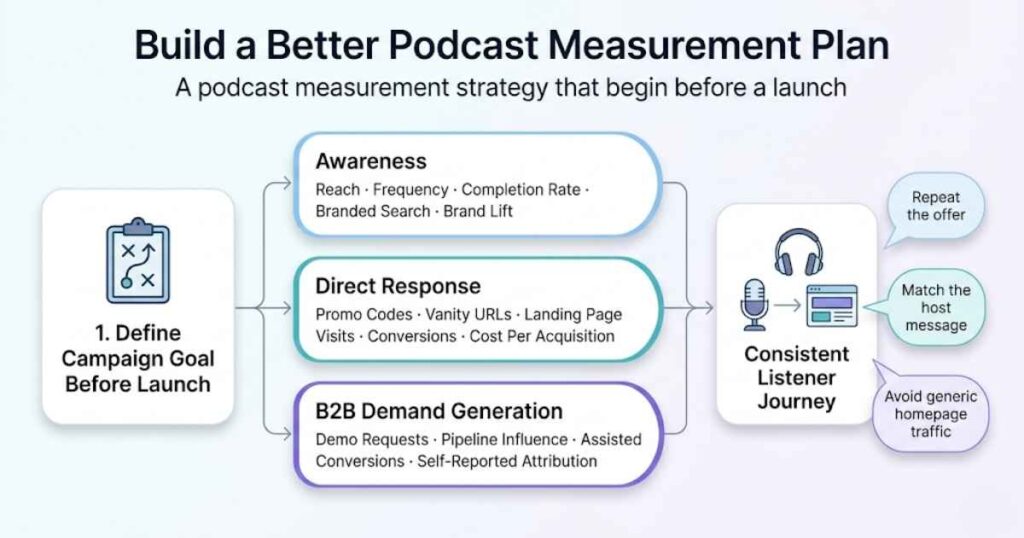
A good podcast measurement plan starts before the campaign goes live. Many teams make the mistake of choosing metrics after the campaign ends, which usually leads to unclear reporting and internal debate. The better approach is to define the campaign goal first, then choose the metrics that match that goal.
If the goal is awareness, focus on reach, frequency, completion rate, branded search, and brand lift. If the goal is direct response, track promo codes, vanity URLs, landing page visits, conversions, and cost per acquisition. If the goal is B2B demand generation, include demo requests, pipeline influence, assisted conversions, and self-reported attribution. For performance-focused campaigns, these conversion signals should ultimately help you measure podcast advertising ROI and determine whether additional spend is justified.
The landing page also matters more than many teams expect. If the podcast ad promises a specific offer, the landing page should repeat that offer clearly. If the host talks about solving a particular problem, the page should continue that message instead of sending listeners to a generic homepage. Measurement improves when the listener journey is simple and consistent.
Practical Takeaways
- Use downloads and streams to understand scale, but do not rely on them alone.
- Track ad impressions to confirm how many times your ad was actually delivered.
- Review unique reach and frequency together before increasing spend.
- Use listen-through rate to understand whether your creative holds attention.
- Track promo codes, vanity URLs, and landing pages for direct response.
- Measure website conversions, but allow for delayed listener action.
- Use brand lift when the goal is awareness, recall, or consideration.
- Define success before launch so the campaign is judged by the right metrics.
Conclusion
Podcast measurement becomes much easier when advertisers stop looking for one perfect number. A podcast campaign can create awareness, trust, search behavior, direct response, and eventual conversions, often across several days or weeks. One metric alone will rarely capture that full journey.
The better approach is to read the numbers together. Downloads show scale. Impressions show delivery. Reach and frequency show exposure. Completion rate shows attention. Promo codes and conversions show action. Brand lift and incrementality show whether the campaign changed perception or created results that would not have happened otherwise. Once you know which metrics consistently correlate with business outcomes, you can use those insights to refine your broader podcast advertising strategy and scale the strongest placements and creative.
That kind of measurement may not be perfectly tidy, but it is far more useful. It gives advertisers the confidence to improve creative, adjust media spend, and scale podcast campaigns with a clearer understanding of what is actually working.
FAQs About Podcast Measurement
What is podcast measurement?
Podcast measurement is the process of tracking how a podcast ad or campaign performs. It includes metrics such as downloads, ad impressions, reach, frequency, listen-through rate, promo code usage, website conversions, and brand lift. Since podcast listeners may act later instead of clicking immediately, advertisers should measure both direct response and broader brand impact.
What is the most important podcast advertising metric?
There is no single most important metric for every campaign. Downloads and impressions help measure delivery, while reach and frequency show audience exposure. For performance campaigns, conversions, promo codes, and landing page visits matter more. For awareness campaigns, brand lift, recall, and branded search are often more useful.
How do advertisers track podcast ad conversions?
Advertisers can track podcast ad conversions through promo codes, vanity URLs, custom landing pages, pixels, post-purchase surveys, and attribution tools. Because listeners may hear an ad on one device and convert later on another, it is best to compare several signals instead of relying on one tracking method alone.
Why are downloads not enough to measure podcast success?
Downloads show potential audience size, but they do not prove that every listener heard the ad or took action. A downloaded episode may not be fully played, and listeners may respond days later through search or direct website visits. That is why downloads should be combined with ad impressions, reach, frequency, completion rate, conversions, and brand lift.