A podcast campaign used to be fairly easy to picture. A brand selected a show, agreed on a host-read advertisement, added a promotional code, and waited to see whether sales followed. That model still has value, but the evolution of podcast advertising has transformed the channel into a much broader ecosystem spanning audio, video, creator partnerships, programmatic media and performance measurement.
Podcasts now sit at the intersection of audio, video, creator marketing, programmatic media and online commerce. A single episode may be heard during a commute, watched on a television and broken into short clips for social platforms. Different audiences may even hear different advertisements within the same episode.
The audience has grown alongside that complexity. Edison Research reported that 58% of Americans aged 12 and above consumed a podcast in the previous month in 2026, while 45% listened or watched weekly. More significantly, 57% had consumed podcasts in both audio and video formats.
What are the New Podcast Advertising Innovations?
For advertisers, that changes the creative brief. Brands are no longer buying access to listeners alone. They are building campaigns that must work across screens, contexts, and different stages of the customer journey.
Podcast Advertising Is Now Designed for Watching and Listening
Video is one of the clearest innovations in podcast advertising for 2026. Calling it an additional format almost understates the change. Podcasts are increasingly being watched on smartphones, laptops and connected televisions, giving advertisers far more creative room than a traditional audio placement.
YouTube has reported more than one billion monthly active viewers of podcast content. The platform also said YouTube Premium users watched over 800 million hours of podcasts in April 2026. These figures suggest that podcasting is no longer confined to headphones; it is becoming part of mainstream television-style viewing.
Why Video Changes the Advertising Brief?
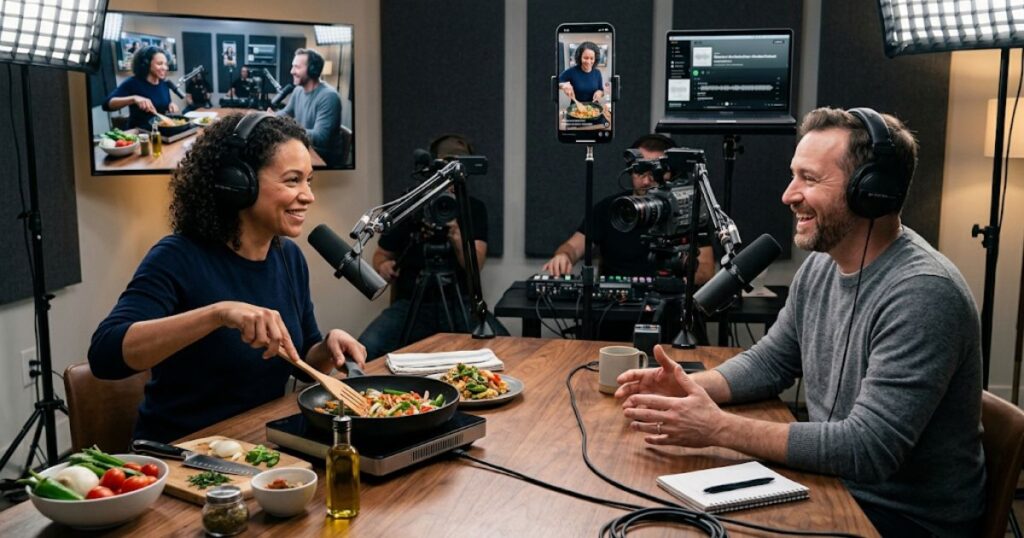
A cookware brand, for example, can still use a conversational host endorsement for audio listeners. On video, however, the host can show the pan, prepare a meal, and demonstrate the final result. The endorsement remains natural, but the product becomes easier to understand.
The strongest campaigns do not create two disconnected advertisements. They begin with one idea that works when heard and becomes richer when watched. That requires closer cooperation between brand teams, creators, and production partners much earlier in the planning process.
AI Is Speeding Up Production Without Replacing Strategy
Artificial intelligence has moved from experimentation into everyday podcast advertising workflows. Brands and agencies are using it to generate early script drafts, produce voiceovers, adapt creative for regional audiences and test different versions of the same message.
Spotify reported in May 2026 that more than 20,000 advertisements had been created by over 7,000 advertisers using its generative-AI advertising tools. The practical appeal is obvious: smaller advertisers can produce professional audio more quickly, while larger brands can create multiple campaign variations without rebuilding every asset from the beginning.
Where AI Adds the Most Value?
AI is particularly useful when a campaign needs several versions. A travel company might create separate messages for families, solo travellers and business passengers. A retailer could adapt offers by city, season or product availability without recording every version manually.
The risk is that easier production can lead to more forgettable advertising. Whether a brand uses AI or human production, learning how to create effective podcast ads still requires strong positioning, a relevant listener problem and a memorable reason to act. A technically polished synthetic voice cannot compensate for weak positioning or vague customer benefits. Human judgment is still needed to decide what the advertisement should say, why the audience should care, and whether the message feels appropriate for the show.

Dynamic Sponsorships Are Giving Old Episodes New Value
Podcast back catalogues often continue attracting listeners for months or years. Historically, however, the advertisements inside those episodes could become outdated. A host might still be promoting a sale that ended long ago, or a product might no longer be available.
Dynamic sponsorship technology is changing that. Eligible creators and publishers can increasingly remove, replace, schedule and measure advertisements within older episodes, while technologies such as postback integration can help performance-focused advertisers pass conversion data between advertising and attribution systems. This allows a January clearance message to be replaced with a spring campaign while preserving the original editorial content.
For publishers, evergreen episodes become renewable advertising inventory rather than archived content. For brands, dynamic placement creates access to relevant episodes long after their original release date. A financial services company, for instance, could place a current savings offer inside an older but still popular episode about personal budgeting.
Programmatic Buying Is Becoming More Transparent
Programmatic podcast advertising once involved a difficult trade-off. Advertisers could gain scale, but they did not always have enough control over the programmes, publishers or contexts in which their advertisements appeared.
That market is becoming more controlled. Private marketplaces, curated inventory and stronger publisher tools are giving buyers greater visibility into placement quality. Spotify has also announced tools allowing Megaphone-hosted publishers to arrange private marketplace deals through its advertising exchange.
Host-Read and Programmatic Ads Serve Different Purposes
Host-read sponsorships are not being replaced by automation. They remain especially effective when a product needs explanation, credibility or personal context. A host discussing their own experience with a budgeting app will usually feel more persuasive than a generic audio spot.
Programmatic advertising serves a different role. It can extend reach, increase frequency, and deliver shorter reminder messages across related shows. A performance podcast advertising strategy may use a host-read advertisement to establish trust, then support it with programmatic placements that increase reach, frequency and opportunities to convert. The sensible approach is not to choose one format automatically. It is to give each format a specific job within the campaign.
Podcast Measurement Is Moving Beyond Downloads
Downloads remain useful because they show whether an episode or advertisement was delivered. Promo codes can also capture direct sales. Neither measure, however, provides a complete picture of how podcast advertising affects customer behaviour.
Modern podcast measurement increasingly combines brand-lift studies, website activity, attention signals, sales matching and incrementality testing rather than relying on downloads or promotional codes alone. Incrementality asks whether the campaign created results that would not have occurred without the advertising.
The Interactive Advertising Bureau reported that US podcast advertising revenue reached $2.43 billion in 2024, representing year-over-year growth of 26.4%. As spending increases, advertisers are naturally demanding more credible evidence of business impact.
Choosing Metrics That Match the Campaign
A campaign designed to introduce a new brand should not be judged only by immediate sales. Brand awareness, search growth and consideration may be more revealing. Advertisers should also define appropriate podcast advertising attribution windows, since listeners may hear an advertisement in one context and convert hours or days later through another device or channel.
The most effective measurement plan begins with one clear business question. Trying to measure every possible interaction often produces a larger dashboard without providing a better decision.
Better Creative Still Depends on the Creator’s Voice
Technology may be transforming podcast advertising, but the medium’s greatest advantage remains human trust. Listeners spend hours with familiar hosts and quickly notice when an advertisement sounds unlike the rest of the conversation.
Brands often weaken that advantage by over-scripting the message. A host may be given a page of mandatory wording, several product claims, and a long list of disclaimers. The result is accurate but rarely engaging.
Strong podcast advertising best practices give creators a few essential facts, one memorable benefit and enough freedom to explain the product naturally rather than forcing them to read an over-scripted commercial. The advertisement still needs boundaries, but it should sound like part of the programme rather than a sudden interruption.
Spotify’s case study involving travel company Contiki offers a useful example. The campaign combined audio, video, user-generated footage and sound-led creative to reach younger UK travellers. Spotify reported a 267% increase in website clicks, with the platform outperforming Contiki’s other advertising channels by 32%.
Platform case studies should always be read with some caution, but the broader lesson is useful: choosing the right format can strengthen an idea, while adding more formats without a clear purpose usually creates noise.

A Smarter Playbook for Podcast Advertisers
Brands planning podcast campaigns in 2026 should focus on a few practical decisions:
- Create an idea that works in audio and gains additional value through video.
- Use AI to produce and test variations, but keep positioning and creative judgment human-led.
- Refresh sponsorships in evergreen episodes rather than letting old inventory lose relevance.
- Combine host-read credibility with programmatic reach when both support the campaign goal.
- Define the business objective before selecting metrics or attribution methods.
- Choose creators based on audience fit and trust, not download numbers alone.
- Give hosts enough freedom to sound natural while protecting essential brand claims.
Final Thoughts about Podcast Advertising Innovations
The most meaningful podcast advertising innovations in 2026 are not isolated tools. Video is expanding discovery, AI is reducing production friction, dynamic placement is making older episodes commercially useful, and improved measurement is giving brands a clearer view of performance.
Yet podcast advertising still succeeds for a remarkably familiar reason: a person the audience trusts explains why something may be useful, interesting or worth buying. Brands that protect that human quality while adopting new technology thoughtfully will be in the strongest position. Those that automate every stage may produce more advertisements. That does not necessarily mean they will earn more attention, trust or sales.
FAQs About Podcast Advertising Innovations in 2026
What are the biggest podcast advertising innovations in 2026?
The most significant developments include video-first podcast campaigns, AI-assisted ad production, dynamic sponsorship replacement and more controlled programmatic buying. Spotify says more than 20,000 ads have already been created through its generative AI tools, showing how quickly automated production is entering everyday advertising workflows.
Why are video podcasts becoming important for advertisers?
Video podcasts allow brands to combine the trust of host-read audio with product demonstrations, visual storytelling and on-screen calls to action. YouTube reports more than one billion monthly active viewers of podcast content, making video an increasingly important part of podcast discovery and consumption.
How can brands measure podcast advertising performance more accurately?
Brands should look beyond downloads and promo-code redemptions by using brand-lift studies, sales matching, website activity and incrementality testing. These methods help determine whether a campaign created additional awareness, customers or purchases rather than simply receiving credit for demand that already existed.
Are AI-generated podcast ads replacing host-read sponsorships?
AI is making it faster and less expensive to create scripts, voiceovers and campaign variations, but it is unlikely to replace trusted host recommendations. Host-read ads remain valuable when a product requires explanation or credibility, while AI and programmatic formats are better suited to testing, localisation and broader reach. Spotify has also introduced policies against unauthorised AI voice impersonation, reflecting the continued importance of creator identity and trust.